Wednesday, June 22, 2011

National Crime Writing Month

On Location with Robert Landori

A Good Memory is a Shortcut to Great Locations
I wrote my very first book on a dare, for a girl-friend whom I had indelicately criticised for reading trash. She had reposted with: “All right smart aleck, if you’re so intelligent why don’t you write me a book that’s better?

Within a year she was reading my first novel.

I hurried to finish the book because I had bet her a dinner that I could perform within twelve months. So I had to look for short-cuts and there was no time for researching “locations”. To solve this problem I delved into my memory banks and chose the venues I knew intimately: Montreal, the Laurentian Mountains, the hospital in which I had worked to earn money as an undergraduate at McGill, the countryside around the English public school I had attended, Georgetown near Washington etc…

I am a lucky man. My work has allowed me to travel far and wide, and to visit enough locations to “situate” at least ten novels.


Galindo’s Turn
(my first novel)
Before he became Robert Lonsdale his name was Bernard Lands.

He lived with his wife, Andrea, in a remote area in the Laurentian Mountains near Montreal. (Picture 1). Islamic terrorists, tipped off by a mole inside the CIA as to his real identity, attempted to assassinate him while he was cross-country skiing, but only managed to wound him.

He was treated at the Royal Victoria Hospital (Picture 2) where the assassins struck again, missed once more, but killed his wife.

Land fled to the Washington area and entered the CIA’s Employee Protection Program where they gave him a new name, a new face and a new identity. He became Robert Lonsdale an obscure analyst with the US Environmental Agency. He bought himself a condo in Georgetown (Picture 3) and started to work for the Agency’s super secret Counter-Terrorism and Counter Narcotics Division (Picture 5).


It took him a year to identify the mole who had betrayed him and whom he then hunted down and neutralized at Frensham Ponds in Surrey, England (Picture 4).

Robert Landori went to school in England, France, Switzerland and Hungary; of necessity he learned eight languages in the process. He completed his education at McGill University in Montreal, became a Chartered Accountant then traveled for over twenty years in the Caribbean and South America as an exporter‑importer, business consultant and trustee in bankruptcy.

Charged with espionage in Cuba, he spent sixty-six days in solitary confinement, and was eventually ‘let go’ without explanation. His experiences in prison prompted him to write his fifth book, Havana Harvest (a story about a Cuban general, condemned to death by the Castro regime).

His first book, GALINDO’S TURN, was the result of a challenge, twenty-five years ago, by a girlfriend to “write an intelligent book within a year”.


Shh... "The Agency’s super secret Counter-Terrorism and Counter Narcotics Division"

Tuesday, June 7, 2011

THE ‘BLOODY WORDS’ OF 2011

This year the combined ARTHUR ELLIS AWARD DINNER / BLOODY WORDS CONVENTION was held in Victoria, British Columbia, a beautiful seaside town.

As usual, I was roped into presenting the Arthur Ellis Prize for the best French Mystery Novel of the year. I took advantage of the situation by practicing my Franglais, a combination of English and French, the nuances of which only Quebecers can really understand.


We were honored to have Lison Lescarbeau with us this year. She’s the ‘Directrice’ of Quebecor Media’s Groupe Librex and oversees the publishing of books through five imprints: Libre Expression, Trécarré, Stanké, Les Éditions Logiques and Les Éditions Publistar. Two of the five finalists came from her stable!


My major contribution, however, was not the Franglais, but a 90 minute information session on MONEY LAUNDERING AND TERRORISM, which I had to prepare and deliver on a couple of hours’ notice as a pinch-hitter. (A work-shop leader became ill at the last moment).

Friday, May 27, 2011

The Venezuelan-Cuban Fiber Optic Cable: A Connection to the World?


Extracts from an article by Vanessa Lopez, a Research Associate at the Institute for Cuban and Cuban-American Studies, University of Miami.

The much anticipated fiber optic cable from Venezuela to Cuba finally reached Cuba’s shores February 8, 2011.

The cable is expected to increase the speed of data, images, and voice transmission by 3,000 times and will be capable of carrying 10 million simultaneous international calls. TGC will also extend the cable to Jamaica.

Although the cable has now reached Cuba’s shore, its complete installation throughout the country is not expected to be complete until July of 2011. Noting that the initial project took double the projected time-frame, it is possible that the July date will be postponed.

Although many Cubans hope that this new cable may improve their chances of accessing the internet, it will do little to expand the population’s access to the World Wide Web. As Waldo Reboredo, the Vice President of Telecomunicaciones Gran Caribe (TGC), stated, what the cable will do, in addition to increasing speed, is provide Cuba with a cheaper alternative to its current system. Reboredo estimates the new cable will reduce costs by twenty-five percent. Whether the Cuban government will reduce the prices paid for internet access by users – primarily foreign businesses, tourists, government officials, and students (who have restricted access) – or if it will maintain prices and pocket the difference, remains to be seen.

There is little question that General Raul Castro’s regime would like to maintain its iron grip on information technology. After all, there is a reason why Cuba has the lowest rate of fixed broadband connectivity in the Western Hemisphere; it has nothing to do with the U.S. economic embargo, despite the government’s attempts to deflect blame. A survey done by Cuba’s National Statistics Office puts the figure of those who have direct access to the internet around 2.9%. And most of that 2.9% consists of government officials or others who have restricted access to the World Wide Web from monitored places of employment or education, and not from the privacy of their own homes (even though home internet usage is monitored as well).

The Castro government sees the internet as a dangerous tool to spread foreign propaganda and disseminate information to a population accustomed to hearing little other than the official Communist Party line. A recently leaked video of Eduardo Fontes Suarez, an official in MININT’s counter-intelligence apparatus, lecturing uniformed members of Cuba’s Armed Forces about the dangers of information technology perfectly depicts the government’s fear. Fontes Suarez speaks to the threat posed by the social networks Facebook and Twitter and the dangers of WiFi as well as the peaceful student group Raices de Esperanza which seeks to promote person-to-person contact between Cuban youth abroad and their counterparts on the island. Cuban blogger Claudia Cadelo explains why: "They don't want the social networks to spread because they are aware of the danger that poses to a totalitarian government which hides the truth from its people."

Renowned blogger Yoani Sanchez agrees, recognizing the government’s intention behind the cable, saying “this underwater connection seems destined more to control us than to link us to the world.” However, Sanchez further writes that she believes that Cubans will be able to circumvent barriers the government will place on internet connections throughout the country, saying “it is quite likely that many of the digital pulses will reach the hands of those who can pay for them. With authorization or without, connection hours will be sold — to the highest bidder — in a country where diversion of resources is a daily practice, a strategy for survival.”

The fiber optic cable is designed to do little more than increase the speed of already existing connections and reduce costs for the Cuban government. This cable connects Cuba to Venezuela; it will be up to the Cuban populace to innovate ways to connect itself to the world.


BLOGGER’S NOTE

IN THE MEANTIME THE GOVERNMENT CHARGES US 2.00 PER HOUR FOR ‘PRIVATE’ INTERNET USAGE IN A COUNTRY WHERE THE AVERAGE MONTHLY OFFICIAL WAGE IS US $25.00. DOES THIS MAKE SENSE?

Sunday, May 22, 2011

On the ‘road’ with CHAPTERS/ INDIGO


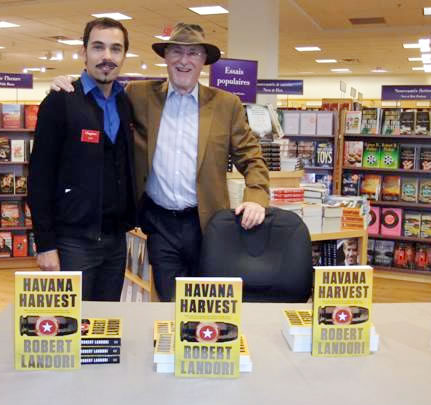
Last Sunday I started my campaign to sell copies of Havana Harvest at the retail level in Canada. I visited my friends at Chapters/Indigo (Canada’s biggest book retailer) and lined up three ‘Meet and Greet the Author events’ to see if I still had the ‘touch’, that is to say the ability to interact with people on a totally spontaneous ‘in-your-face’ basis.

I’m happy to report that the first such event – at Chapters’ Fairview Mall store – went off without a hitch on May 15.

In fact, it was remarkably successful; I left the Managers with big smiles on their faces.

Sunday, May 1, 2011

CRIME WRITERS IN ACTION

Crime Writers of Canada (CWC), of which I am a member, organized an extended interviewing session on 102.3 FM Radio Centre Ville’s program called Contes a Rendre (Happenings) with three authors (two French and one English).

The bilingual show ran from 6 to 8 a.m. on Sunday, May 1, 2010, and was an unqualified success.

Each of us was asked to say a few words about our respective books and then to read a short extract from it.

We had a lot of fun so I thought you would be glad to see the pictures that were taken to show three hard-working Canadian authors slaving away on a Sunday at the crack of dawn.


If you’re interested in what was said, you can catch the podcast by clicking on the play button:


Saturday, April 16, 2011

Woman dies from mad cow disease in Spain (CNN)


I was on my way back to Montreal and got to talking with the man sitting next to me on the plane. When I told him that I was a writer and that one of my books (FATAL GREED) was about Human Mad Cow (Creutzfeldt-Jakob’s) Disease he became very agitated. He said that two members of his extended family (a mother and her son) had died of nvCJD some years ago and that, as far as he was concerned, the disease was hereditary.

I found this hard to believe because, when I researched the topic for my book, I read that humans become infected either through coming into contact with incorrectly sterilized surgical instruments, or through eating contaminated tissue (for example beef).

Sure enough, a couple of days after my arrival home CNN reported as follows.

MADRID, Spain (CNN) -- A Spaniard has died from the human form of mad cow disease, the fifth such death in Spain since 2005, the Ministry of Health said in a statement late Friday.

The victim was a woman who was hospitalized last fall, according to Juan Jose Badiola, director of Spain's national research center for mad cow disease.

The Spanish Ministry of Health reiterated that there is no danger from eating meat in Spain.

"The appearance of these sporadic cases is within the predictions that were made at the European level more than nine years ago," the ministry statement said.

Ten years can pass between eating contaminated tissue and the appearance of the human form of the disease also called variant Creutzfeldt Jakob disease, health officials say.

The first confirmed death from mad cow disease in Spain was in 2005, when a young woman died near Madrid.

The article went on to state that, last September officials reported the death of a woman and her son from the human form of mad cow disease .This was believed to have been the first case in the world where two members of the same family have died from the disease. However, and this is important, the mother and her son had the same eating habits which included eating animal organs, such as kidneys and livers, and they may also have eaten animal brains.

It seems my seat-mate on the plane was, indeed, mistaken.

What is certain though is that, in some cases, nvCJD has an incubation period that has to be measured in decades and not in months. Consequently, only time will tell (decades) how many of us are already infected with this disease.

Given the fact that the USDA only tests one cow out of every 2,000, no one really knows how many of these infected animals may have already entered the human food supply.

Sunday, April 3, 2011

GREED CAN BE FATAL (2)

We don’t realize what risks we are taking in our mad rush to invent ever more efficient methods of production to satisfy the consumerism so prevalent throughout the world. We cut corners willy-nilly to make things and provide services as cheaply as possible so as to be able to sell, sell, sell, thereby feeding the ‘bottom line’ of the huge corporations that generate what we consume. No industry – and especially not the food industry – is safe from shortsightedness when it comes to trying to increase efficiency. We force-feed the chickens and the cattle that we eat, we treat our dairy and vegetable products with chemicals so that they ripen quicker and keep their freshness longer and we try to ‘reduce waste’ wherever feasible. One such effort to ‘reduce waste’ (and increase profitability) was to mix into the feed destined for consumption by our cattle the finely-ground remains of dead cows and bulls. The result was catastrophic, not only for the animals that consumed this tainted fodder, but also for the human race. The animals involved developed BSE – Bovine Spongiform Encephalopathy (BSE), or MAD COW DISEASE. (Their brain matter literally turned to mush resembling sponges – hence the name). BSE was first reported in the UK in 1986. Since that year, according to the world health Organization (WHO) about two hundred thousand cases have occurred in the UK. BSE in the UK began to decline in 1992 and has continuously declined year by year since then. Unfortunately, however, BSE has spread to 21 other countries. This is bad news, but not as bad as the news that the disease had mutated into a new form: HUMAN BSE. When BSE material infects humans the resulting disease is known as (new) variant Creutzfeldt-Jakob’s Disease (nvCJD). It is invariably fatal.
My book, FATAL GREED, is about a hypothetical occurrence in which surgical glue, manufactured from bovine blood, is accidentally infected by nvCJD. The glue is sent out to hospitals around the world where unsuspecting surgeons start using it thereby infecting and killing thousands of people. FATAL GREED is available in hard-cover and eBook form from Amazon.com. Its plot is entirely plausible and very topical.

Sunday, March 20, 2011

FATAL GREED

FATAL GREED (GREED CAN INDEED BE FATAL)


Mergers, Acquisitions and Corporate Finance are businesses that constantly challenge the mettle and moral fortitude of those who earn their keep with this dark Art.
I should know, I was one of its practitioners for over three decades.
But then, the world of business is widely peopled by men of questionable morality. Why else did we have to witness the Ponzi scheme of a Madoff or the highly questionable practices of the top executives of Wall Street's most prestigious bankers?

Chicanery in business appalls me so I wrote a book about it and called it FATAL GREED (because greed can, indeed, be fatal at times).

THE BOOK HAS JUST APPEARED IN DIGITAL FORM.
My story is about two men who manufacture surgical glue from bovine blood, and, by mistake, infect a batch with human Mad Cow Disease.
The infected glue gets shipped out to hospitals everywhere and people start dying from it.
When the two realize what they have done they can't agree on what to do next.
They fight.
The bad guy kills the good guy and runs away with the money they had made selling the glue.
Their company goes bankrupt. The glue becomes an orphan and an excellent candidate for being turned into a Weapon of Mass Destruction.

TO FIND OUT WHAT HAPPENS TO THE GLUE AND THE BAD GUY READ FATAL GREED. IT'S AN ENTIRELY BELIEVABLE AND TOPICAL STORY.

Sunday, March 13, 2011

WHERE ARE YOU HEADED FIDEL?

Some months ago (see my September 30, 2010 blog) I commented about how Fidel was proposing to refloat his flagging economy by allowing Cubans to start small businesses, the idea being that those who had access to money in the US would ask friends and relatives there to finance the establishment of micro enterprises on the island.

Surprisingly, the ponderously slow-moving Cuban bureaucracy has somehow managed to issue over 75,000 licenses to budding entrepreneurs by the end of 2010 thereby almost doubling the number of officially self-employed people. Of course, there is a way to go yet – according to the Cuban labor federation, within the next thirty days Raul expects to lay off about half a million of the over 4 million workers employed by the State (about 80 per cent of those who have jobs in Cuba).

Although most of the new entrepreneurs are earning more now than they were when their government paid them $20 per month as bureaucrats, they have started to worry about whether the market will support hundreds of thousands of freelancers. What is certain, though, is that the fledgling businesses are winning hearts and minds: people like to see drab streets coming to life as freshly painted signs and colorful awnings start to appear not only in Havana but also in towns right across the Republic.


An interesting side effect of this development is its impact on state-run enterprises: people prefer to frequent establishments run by private owners rather than by the State because they get better service and more value for their money. Thus, the freelancers do not only represent an emerging new middle class, but also real competition for state-owned businesses that have now begun to lose custom at an alarming rate.

Meanwhile, the Castro Brothers are preparing for the VI Congress of the Cuban Communist Party at which it is presumed the party’s Polit Bureau will evaluate the situation of the country’s affairs, the problems it faces, and the solutions the Bureau proposes to overcome them.

Presumably those militants invited to the Congress will be allowed to comment and ask questions. One of the questions is bound to be: WHITHER FIDEL CASTRO?

Will he stand for ‘re-election’ for the post of First Secretary of the Party? Will he cede this, the most powerful post in the land, to his brother, Raul? Will he content himself to be Number Two not only in law but in fact as well?

Or will he just fade away? (I DOUBT IT.)

Saturday, March 5, 2011

REWARDS

A writer struggles to be inspirationally creative, imaginatively informative and excitingly entertaining while fighting for market share and critical recognition. Not easy to have all these balls in the air at the same time.

But at times the rewards – and I’m not talking about financial rewards – are quite amazing. Yes, at times the light is worth the candle.

I received two such rewards last week.

The first was an extraordinarily civilized interview with Jason Hartman, the host on the JetSetters radio show. Listen to how well it went by clicking on


You can also read about what was said by going to http://jetsettershow.com/category/podcast/

The second was most touching. My publisher sent me a large envelope that contained a greeting card and an in-depth analysis (12 handwritten pages) by Isabelle MacWilliam of Toronto, Canada of my book Havana Harvest.

She quotes Chapter 3, page 24, para 3: “He was not lonely, just alone, and he enjoyed being so” and then she goes on: “Essentially I comprehend this very personal salient statement of Lonsdale [the the principal character of Havana Harvest.] For a whirligig of intervening time after a person close to one dies, the sanguine is set aside for a spell.”

Elegantly put.

Thank you for understanding.