Sunday, April 3, 2011

GREED CAN BE FATAL (2)

We don’t realize what risks we are taking in our mad rush to invent ever more efficient methods of production to satisfy the consumerism so prevalent throughout the world. We cut corners willy-nilly to make things and provide services as cheaply as possible so as to be able to sell, sell, sell, thereby feeding the ‘bottom line’ of the huge corporations that generate what we consume. No industry – and especially not the food industry – is safe from shortsightedness when it comes to trying to increase efficiency. We force-feed the chickens and the cattle that we eat, we treat our dairy and vegetable products with chemicals so that they ripen quicker and keep their freshness longer and we try to ‘reduce waste’ wherever feasible. One such effort to ‘reduce waste’ (and increase profitability) was to mix into the feed destined for consumption by our cattle the finely-ground remains of dead cows and bulls. The result was catastrophic, not only for the animals that consumed this tainted fodder, but also for the human race. The animals involved developed BSE – Bovine Spongiform Encephalopathy (BSE), or MAD COW DISEASE. (Their brain matter literally turned to mush resembling sponges – hence the name). BSE was first reported in the UK in 1986. Since that year, according to the world health Organization (WHO) about two hundred thousand cases have occurred in the UK. BSE in the UK began to decline in 1992 and has continuously declined year by year since then. Unfortunately, however, BSE has spread to 21 other countries. This is bad news, but not as bad as the news that the disease had mutated into a new form: HUMAN BSE. When BSE material infects humans the resulting disease is known as (new) variant Creutzfeldt-Jakob’s Disease (nvCJD). It is invariably fatal.
My book, FATAL GREED, is about a hypothetical occurrence in which surgical glue, manufactured from bovine blood, is accidentally infected by nvCJD. The glue is sent out to hospitals around the world where unsuspecting surgeons start using it thereby infecting and killing thousands of people. FATAL GREED is available in hard-cover and eBook form from Amazon.com. Its plot is entirely plausible and very topical.

Sunday, March 20, 2011

FATAL GREED

FATAL GREED (GREED CAN INDEED BE FATAL)


Mergers, Acquisitions and Corporate Finance are businesses that constantly challenge the mettle and moral fortitude of those who earn their keep with this dark Art.
I should know, I was one of its practitioners for over three decades.
But then, the world of business is widely peopled by men of questionable morality. Why else did we have to witness the Ponzi scheme of a Madoff or the highly questionable practices of the top executives of Wall Street's most prestigious bankers?

Chicanery in business appalls me so I wrote a book about it and called it FATAL GREED (because greed can, indeed, be fatal at times).

THE BOOK HAS JUST APPEARED IN DIGITAL FORM.
My story is about two men who manufacture surgical glue from bovine blood, and, by mistake, infect a batch with human Mad Cow Disease.
The infected glue gets shipped out to hospitals everywhere and people start dying from it.
When the two realize what they have done they can't agree on what to do next.
They fight.
The bad guy kills the good guy and runs away with the money they had made selling the glue.
Their company goes bankrupt. The glue becomes an orphan and an excellent candidate for being turned into a Weapon of Mass Destruction.

TO FIND OUT WHAT HAPPENS TO THE GLUE AND THE BAD GUY READ FATAL GREED. IT'S AN ENTIRELY BELIEVABLE AND TOPICAL STORY.

Sunday, March 13, 2011

WHERE ARE YOU HEADED FIDEL?

Some months ago (see my September 30, 2010 blog) I commented about how Fidel was proposing to refloat his flagging economy by allowing Cubans to start small businesses, the idea being that those who had access to money in the US would ask friends and relatives there to finance the establishment of micro enterprises on the island.

Surprisingly, the ponderously slow-moving Cuban bureaucracy has somehow managed to issue over 75,000 licenses to budding entrepreneurs by the end of 2010 thereby almost doubling the number of officially self-employed people. Of course, there is a way to go yet – according to the Cuban labor federation, within the next thirty days Raul expects to lay off about half a million of the over 4 million workers employed by the State (about 80 per cent of those who have jobs in Cuba).

Although most of the new entrepreneurs are earning more now than they were when their government paid them $20 per month as bureaucrats, they have started to worry about whether the market will support hundreds of thousands of freelancers. What is certain, though, is that the fledgling businesses are winning hearts and minds: people like to see drab streets coming to life as freshly painted signs and colorful awnings start to appear not only in Havana but also in towns right across the Republic.


An interesting side effect of this development is its impact on state-run enterprises: people prefer to frequent establishments run by private owners rather than by the State because they get better service and more value for their money. Thus, the freelancers do not only represent an emerging new middle class, but also real competition for state-owned businesses that have now begun to lose custom at an alarming rate.

Meanwhile, the Castro Brothers are preparing for the VI Congress of the Cuban Communist Party at which it is presumed the party’s Polit Bureau will evaluate the situation of the country’s affairs, the problems it faces, and the solutions the Bureau proposes to overcome them.

Presumably those militants invited to the Congress will be allowed to comment and ask questions. One of the questions is bound to be: WHITHER FIDEL CASTRO?

Will he stand for ‘re-election’ for the post of First Secretary of the Party? Will he cede this, the most powerful post in the land, to his brother, Raul? Will he content himself to be Number Two not only in law but in fact as well?

Or will he just fade away? (I DOUBT IT.)

Saturday, March 5, 2011

REWARDS

A writer struggles to be inspirationally creative, imaginatively informative and excitingly entertaining while fighting for market share and critical recognition. Not easy to have all these balls in the air at the same time.

But at times the rewards – and I’m not talking about financial rewards – are quite amazing. Yes, at times the light is worth the candle.

I received two such rewards last week.

The first was an extraordinarily civilized interview with Jason Hartman, the host on the JetSetters radio show. Listen to how well it went by clicking on


You can also read about what was said by going to http://jetsettershow.com/category/podcast/

The second was most touching. My publisher sent me a large envelope that contained a greeting card and an in-depth analysis (12 handwritten pages) by Isabelle MacWilliam of Toronto, Canada of my book Havana Harvest.

She quotes Chapter 3, page 24, para 3: “He was not lonely, just alone, and he enjoyed being so” and then she goes on: “Essentially I comprehend this very personal salient statement of Lonsdale [the the principal character of Havana Harvest.] For a whirligig of intervening time after a person close to one dies, the sanguine is set aside for a spell.”

Elegantly put.

Thank you for understanding.

Wednesday, February 23, 2011

START OF UNREST IN CUBA?

“Los Aldeanos” is one of the most rebellious groups of rappers in Cuba. Using admittedly vulgar language, their songs aggressively attack the deficiencies of life on that island.

Last week they were the center of a ‘a public scandal’ in Holguin after they had tried to visit two young brothers, incarcerated since December 25 for having “played the duo’s music too loud”.

They were not allowed access, so they went to visit the brothers’ home where their presence attracted over 1500 young people of whom about 80 were arrested and five wounded. During this ‘public disturbance’ the police were pelted with stones.


On another topic, this week I was very pleasantly surprised to see Havana Harvest as #1 on a list of fantastic international fiction on Amazon.com!

Sunday, February 20, 2011


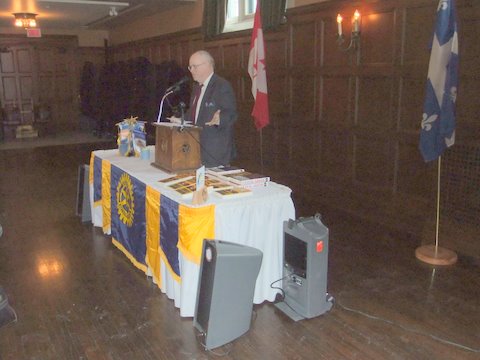
The Westmount (Montreal) branch of Rotary asked me to speak about Cuba and my novel, Havana Harvest, at their weekly get-together last Wednesday.

I was amazed by how many of those attending had already been to Cuba or were planning to go this Spring. Naturally, they were interested in getting information about present conditions in that country, but their predominant preoccupation can be summed up by this question: “What will happen after the Castro Brothers leave the scene?”

I told them about the Cuban Transitional Project undertaken by the University of Miami’s Institute for Cuban and Cuban-American studies and more particularly about the work of Professors Jose Azel and Brian Latell who are attempting to develop a model of what is likely to happen. I cautioned them about expecting fundamental changes any time soon because, in my opinion, Raul Castro’s control over the military, the government and the communist party seems to be secure – at least for the time being.

I also took the opportunity to say a few words about the imminent launch of a digital edition of Fatal Greed, my novel about a batch of surgical glue, infected by human Mad Cow disease that Islamist terrorists were planning to use as a Weapon of Mass Destruction.

Monday, January 31, 2011

CUBA AND PARMALAT – A SPECTACULAR FRAUD

CUBA AND PARMALAT – A SPECTACULAR FRAUD

Although Fidel Castro, now in his mid-eighties, is being accused of many misdeeds, we must acknowledge that the revolution he led did a lot of good things for the Cuban people initially: the establishment of an effective health care system accessible to all, and the eradication of illiteracy, to mention just two.
His regime also became unwittingly involved in a number of spectacular frauds, one of which was perpetrated by the owners of Parmalat, the giant Italian milk conglomerate.

Shell companies and “cut and paste” forgery were combined with more traditional fraud, such as the falsifying of sales figures via phony invoices. In one particularly flagrant case of “cooking the books,” Parmalat’s Cayman Islands subsidiary Bonlat claimed to have sold enough powdered milk to Cuba in one year to produce 55 gallons of milk for each one of the small island nation’s citizens.

The fraud was not discovered for a long time because the Cuban authorities routinely refuse to cooperate with large independent auditing firms and do not acknowledge the existence of accounts payable. In the Parmalat case the auditors, in turn, never bothered to seek alternative means of verification, such as examining shipping receipts, for example.

The Parmalat fraud is typical of the cases I had the opportunity to investigate as a Bankruptcy Trustee and Forensic Accountant and some of which I interwove into my novels, HAVANA HARVEST and FATAL GREED.

Friday, January 28, 2011


My presentation at the annual Sherlock Holmes dinner of the Bimetallic Society of Montreal on Saturday, January 22, 2011 – attended by a crowd of over sixty enthusiasts in spite of sub-zero weather – went rather well, even if I say so myself.

I prepared a semi-fictitious story for the occasion, constructed so that I could keep ‘em guessing for a quarter of an hour, until the very last moment. When I finally pulled the ‘rabbit’ out of my ‘hat’ (Holmes’ pipe out of a box) the room dissolved into laughter and enthusiastic clapping.

The venue was elegant, the food good, and the costumes fetching.


I was amazed to learn that there were over 800 active Sherlockian Society branches around the world, (we need another link here) each of which has one member charged with reading the obits. in the London Times daily to make sure no announcement of Sherlock Holmes’ demise has appeared. The Sherlockians hold that Holmes is still alive. Their ‘logical’ argument supporting such a belief goes something like this:

Sherlock Holmes was an important public figure.

The Times automatically publishes an obituary for every such person.


No such obit has thus far appeared.
Therefore, Sherlock Holmes is still alive – somewhere.
QED – Quod Erat Demonstrandum.

Sunday, January 23, 2011

MAÑANA IN CUBA

It has become fashionable, of late, to wonder out loud and in detail about what would happen in Cuba once the regime changed.

Of course, gazing into the future requires an analysis of the past and the present.

One of the most compelling of such analyses is a book written by Jose Azel and entitled “Mañana in Cuba”. Dr. Azel is well qualified to speak on the topic. He is currently a Senior Scholar at the Institute for Cuban and Cuban-American Studies at the University of Miami.

I found the following passage in his book most telling:

“Unfortunately, the Cuban transition to democracy and free markets is highly unlikely to follow the path of some of the most successful Eastern European countries that faced similar, but not identical challenges. Cuba´s post-Castro interregnum [...a period of discontinuity of government organization or social order...] will be, arguably, the most critical period in the nation’s history. It will be a period during which inexperienced post-Castro leaders will face myriad social, political and economic policy decisions. Unseasoned leaders will need to make strategic, tactical and operational policy choices that will impact not only the existing circumstances, but the nation’s immediate and long-term future. And, in all probability, this will have to take place in an environment of socio-political and economic disarray and confusion, if not outright chaos.” (Italics mine).

Will Uncle Sam just stand or will he interfere?

Your guess is as good as mine.

Wednesday, January 19, 2011

ICCAS RECEPTION

On December 15, 2010, my friends Olga Connor (the well-known journalist) and Agustin Rivero organized a reception at Miami University’s Institute for Cuban and Cuban-American Studies, after which Dr. Jaime Suchlicki, (the Director of the Institute) joined me to reviewed my latest novel, Havana Harvest for a group of over fifty aficionados who braved the unseasonably cold weather to venture outside.

I was amazed by how much Dr. Suchlicki’s analysis of the real reason why General Ochoa was executed coincided with what I had conjured up in my totally fictional work.

I was likewise gratified to see that one of the late General Ochoa’s close acquaintances also attended the meeting.

The Institute, which Dr. Suchlicki helped found in 1999, is the authority in the US on what is going on in Cuba today and in which direction that island’s socio-political development is heading.